

The Smile Design Process: How We Plan Your Smile Using Photos, Video, and Your Own Old Pictures
Services
February 17, 2026


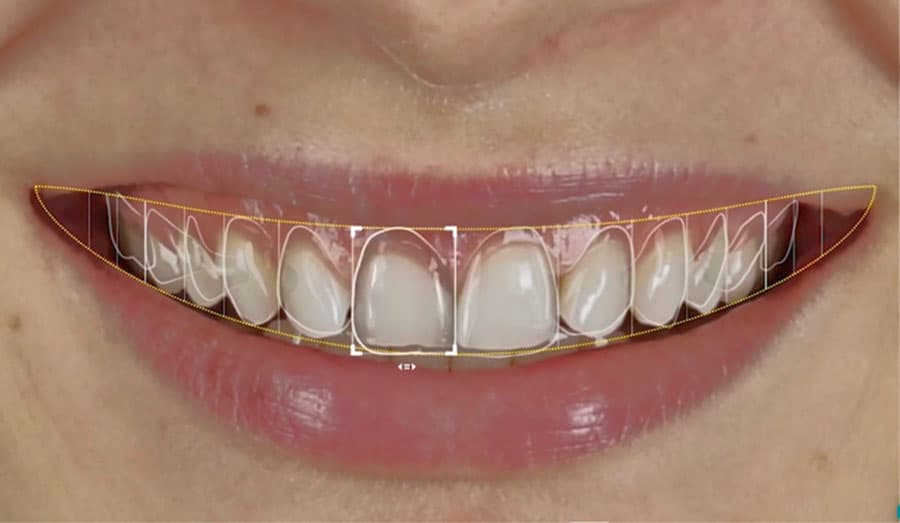
Before we talk about veneers or crowns or bonding, we talk about photos. That's the first thing most new patients are surprised by. I take photos of your smile, I take a short video of you talking, and if you can bring me old pictures of yourself from years ago, we'll look at those too. The planning starts long before anyone picks up a drill.
Smile design is the clinical planning process I use to decide what a smile should look like before any treatment begins. At Redefine Dental, it starts with a set of standardized photos and a short video of you talking and smiling naturally, then moves into a three-question framework: how many teeth am I going to restore, what's the harmony of the gum tissue, and what else do I have around these teeth that matters? The result is a plan that gets reviewed with you before any appointment where work actually happens.
When you walk in for a smile design consultation, your teeth aren't what I'm looking at first. Your face is.
I'm looking at the proportion between your lips and your teeth when you're resting. The way your smile changes when you're talking versus when you're smiling for a camera. How much tooth shows when you say a soft "e" sound. Whether your central incisors match your face shape. How your smile sits inside the frame of your overall features.
None of that shows up in a mirror, and almost none of it shows up looking directly into your mouth in a chair. It shows up in photos. So that's where we start.
Specifically, I take:
The video is the one most patients don't expect. Photos capture one frozen moment. Video captures how your smile actually behaves. People smile differently when they're posing than when they're mid-conversation. The work we design has to look right in both.
Once I have the photos and the video, I sit with them. There are three questions I ask every single case, and I ask them in the same order.
This sounds simple. It's the question that changes the most about a treatment plan.
Take a case I worked on a while back. A young patient came in wanting bonding. When I looked at his photos, he had significant spacing across his upper arch. Bonding would have closed the spaces, but porcelain would be more predictable long-term, and it would be easier for him to keep clean. More importantly, he was showing 10 teeth when he talked, second premolar to second premolar. His lower arch was healthy and looked beautiful. So we decided to cover only the upper. The "how many teeth" question answered itself once I saw the video.
The way I answer it in every case is the same: how many teeth is this patient actually showing when they talk or smile? Not when they pose. When they talk. That's the question, and the photos plus the video answer it.
This is the one most patients don't know to ask about. Gum tissue is part of smile design. A veneer on a tooth where the gum line is a millimeter lower than the tooth next to it will always look asymmetrical, no matter how beautiful the porcelain is.
I look for gum tissue symmetry across centrals, across laterals, and from canine to canine. If there's asymmetry, I have to decide whether we're going to live with it, or whether we do gum contouring before the restorative work so the final result actually looks balanced.
A case of peg laterals (two undersized side teeth) I planned recently needed both. The patient was happy with her centrals and her canines. What she didn't love were the laterals, and what I noticed was that the gum tissue over one lateral sat lower than the gum tissue over the other. If I'd just restored both laterals with porcelain veneers without doing gum contouring first, one would have looked longer than the other. So we lifted the gum tissue up on both laterals and on the centrals for symmetry, and then placed two porcelain veneers. That extra step is what made the final result look natural instead of imbalanced.
The third question is about context. What are the teeth on either side of the ones I'm restoring doing? Are the canines healthy? Are the centrals a color I should match to, or a color I should change?
This is where old photos become useful.
If you have photos of yourself from your twenties, or from before you started having issues with your teeth, bring them. I mean it.
For one patient, we spent 20 minutes of the consultation looking at photos he'd pulled up on his phone from a decade earlier. His front teeth had been ground down over years of bruxism, and by the time he came to me they'd lost most of their original shape. When we planned his full mouth reconstruction, we didn't have to guess what his natural teeth had looked like. We could match them. The canines had a specific curve. The centrals had a slight angle where they met. Those are details you can't invent and you don't want to. You want to restore them.
Even patients who aren't doing full reconstructions benefit from old photos. They tell me what your teeth used to look like before whatever we're fixing started, and they tell me what you used to feel comfortable smiling with. "Natural" is different for different people. Your old photos show me what it was for you.
Once I've answered all three, I build a treatment plan and we go through it together. Depending on the case, that might include:
None of this is just technical planning. It's also how you get to weigh in. A lot of what we're deciding is aesthetic, and I can't make aesthetic decisions for you. What I can do is show you the options before anything is irreversible.
I went to NYU for my DDS and trained at the Kois Center afterward. Both of those shaped the way I think about smile design in one specific way: function comes first, aesthetics come second.
Most smile makeover marketing works the other way around. "Hollywood smile," "dream smile," "makeover in a day." Those sell. But teeth that look beautiful and don't function correctly will break, or wear, or cause headaches from a bad bite. That's not a smile makeover I want to be responsible for.
So the smile design process at Redefine Dental spends a lot of time on function before we get to aesthetics. I'm looking at your bite. I'm looking at how your teeth come together. I'm looking at whether you're grinding. If any of those need to be addressed before the cosmetic work, we address them first.
Then we make things beautiful.
The first smile design consultation at Redefine Dental is usually about 60 to 90 minutes. Here's what typically happens:
Patients who've been to multiple cosmetic consultations before are often surprised by how different the conversation feels. It's slower. It involves more of your input. And very often, the plan we land on is less than what was proposed elsewhere.
If you're considering cosmetic dentistry in Dallas and you want to understand what goes into the planning, the next step is to book a smile design consultation . Come in with your questions. Bring your old photos if you have them. We'll take it from there.